

H-Cube® Systems
On-demand hydrogen and continuous flow technology
Hydrogenation in Flow
The first H-Cube® system revolutionized laboratory hydrogenation when it was introduced in 2005, earning the prestigious R&D Top 100 award for ThalesNano in the same year. Since then, these reactors have established a new industry standard by combining on-demand hydrogen generation and continuous flow technology within a single instrument. The product family comprises three different reactors, catering to a wide range of user requirements.
The H-Cube® Mini Plus stands out for its user-friendly design, offering a modern and streamlined version of its original counterpart. With enhanced ease of use, this instrument ensures efficient small-scale laboratory hydrogenation.
On the other hand, the H-Cube® Advance is specially designed for complex hydrogenations and chemical synthesis with gases other than hydrogen. The built-in mass flow controller and the external gas inlet enables reactions with 14 different gases. Moreover, the flow reactor provides a wider temperature range (0-150 °C), higher hydrogen production rate, and an user-friendlier interface than its predecessor, the H-Cube® Pro. The H-Cube® Advance flow reactor's Hastelloy version is made out of Hastelloy C, enabling reactions with corrosive materials, like acids and chlorines.
With their cutting-edge features and capabilities, these flow hydrogenation reactors continue the legacy of the H-Cube® system, pushing the boundaries of laboratory hydrogenation technology. Over the years, they have been used all around the world for a wide range of applications and have been featured in numerous scientific publications.
Learn more about our latest flow reactor
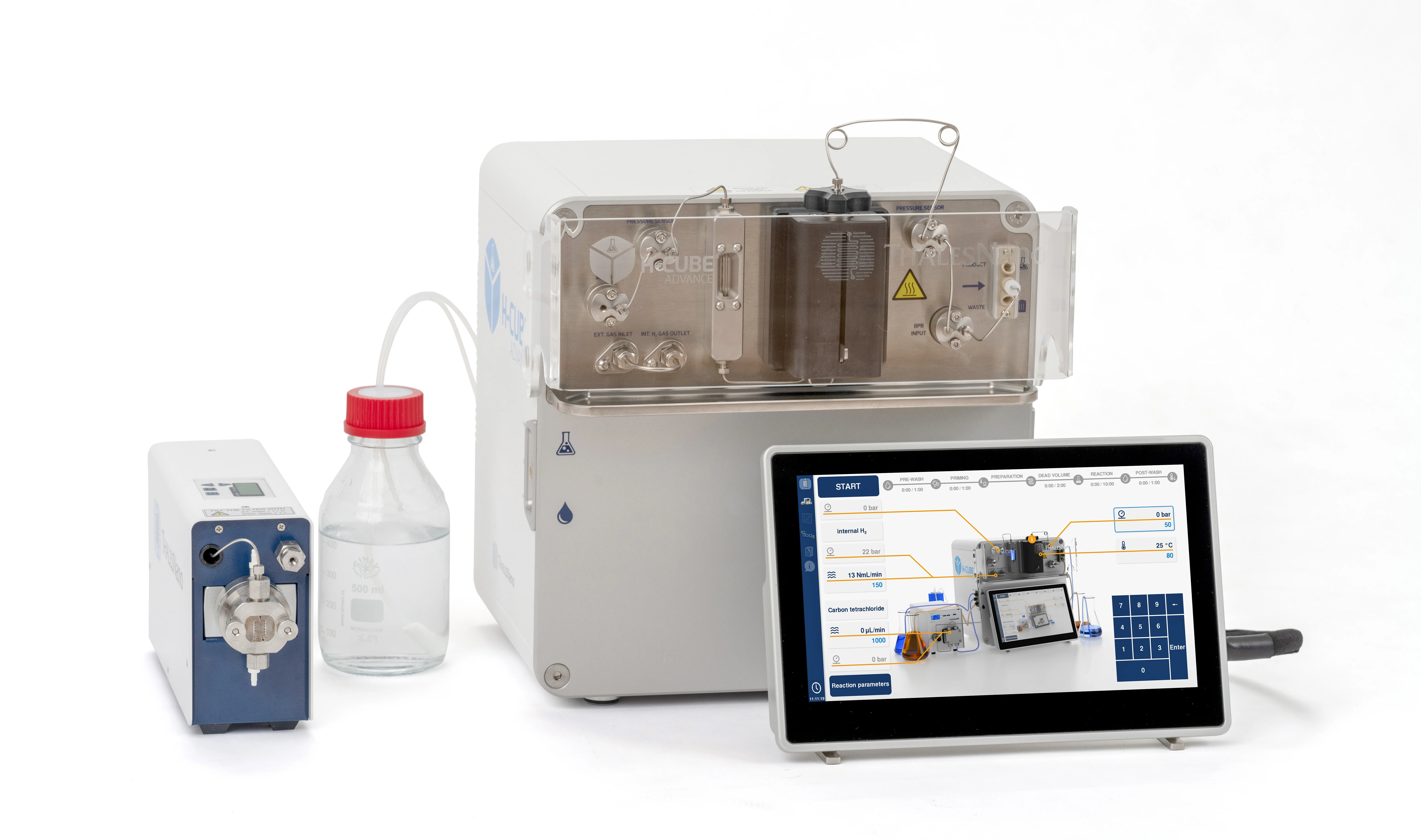
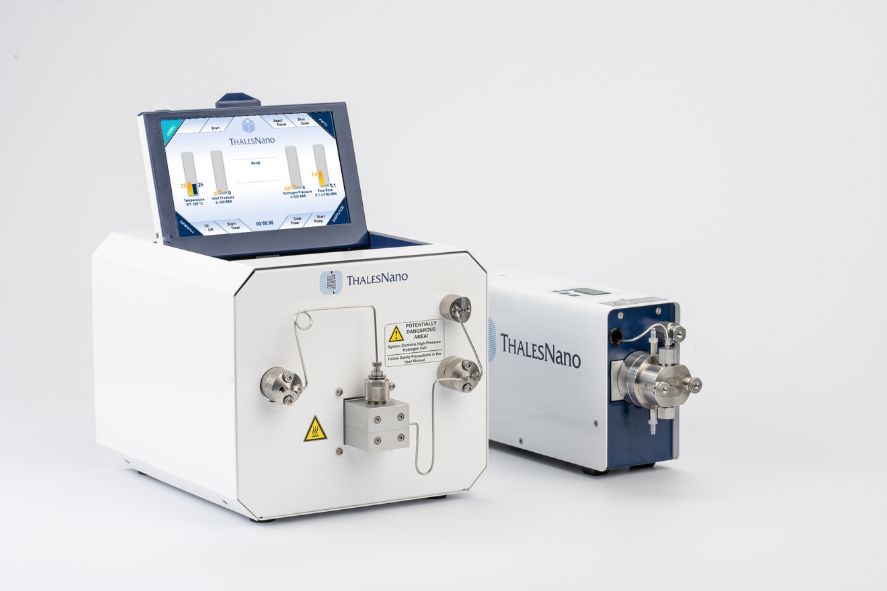
H-Cube® Advance
Advanced hydrogenation and chemical synthesis
H-Cube® Advance Hastelloy
Applications with corrosive materials
H-Cube® Mini Plus
Safe and easy hydrogenation
Compare specifications
| Features | H-Cube® Mini Plus | H-Cube® Advance |
| Temperature range | Ambient - 100 °C | 0 - 150 °C |
| Pressure range | Atmospheric - 100 bar | Atmospheric - 100 bar |
| H2 generation | On-demand | On-demand |
| H2 gas flow rate | 0.1 - 30 mL/min | 1 - 70 mL/min |
| Liquid flow rate | 0.3 - 3 mL/min | 0.01 - 10 mL/min |
| External gases | No | Through an external gas inlet |
| Software & interface | Limited screen/menu | 10” touchscreen with live feedback |
| Scalability | Standalone | Part of a scalable flow reactor network |
| Reaction monitoring | Basic | Real-time data logging & export |
| Safety features | Standard | Smart pressure relief, auto-shutdown |
| Water reservoir capacity | 100 mL | External - variable sizes |
| Available versions | SS-316 | SS-316, C276 |
Applications
Reactions with hydrogen gas:
- Triple bond full reduction
- Debenzylation
- Nitrile reduction
- Selective nitro reduction
- Selective triple to double bond reduction
- Selective double bond reduction
- Aldose reduction
- Aromatic heterocycle reduction
- Aromatic ring reduction
Other reactions:
- Deuteration
- Sonogashira coupling
- Suzuki coupling
Do you have more questions?
Reach out to us at any time and experience fast and efficient support tailored to your specific needs.