
Continuous Hydrogenation for the Manufacture of Albuterol Sulfate
Ferri et al.; Applied Catalysis A: General, 2026, 724, 121086
A recent publication in Applied Catalysis A: General demonstrates how continuous-flow technology can simplify the manufacture of albuterol sulfate. This key bronchodilator is mainly used for the treatment of obstructive pulmonary disease (COPD), emphysema, and asthma. Among many other pharmaceutical compounds albuterol sulfate has been facing supply shortages in the United States due to supply chain disruptions, economic fluctuations, and inconsistent product quality.
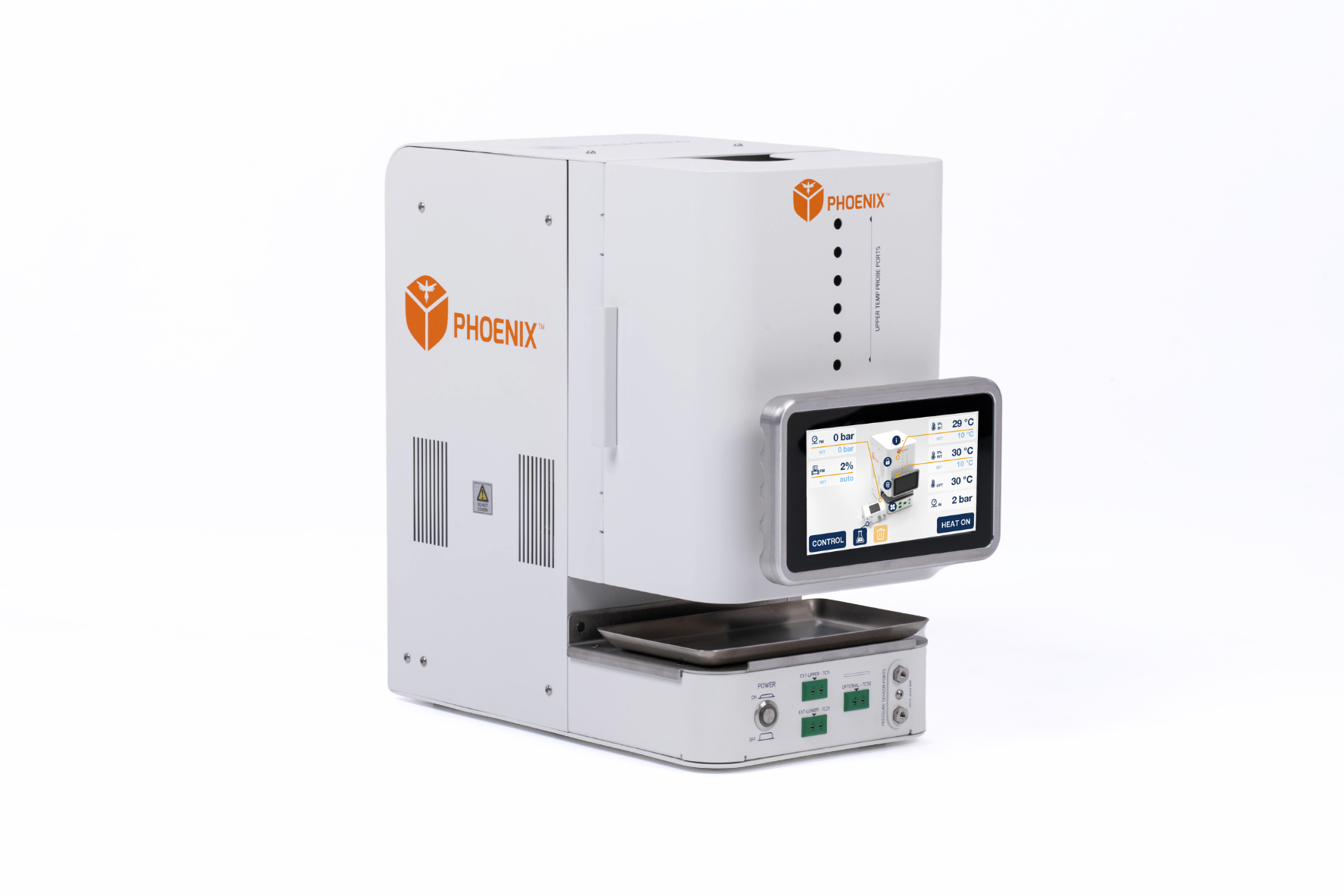
At the core of this study is the Phoenix™ Flow Reactor, used to perform the catalytic hydrogenation step in continuous flow. The proposed approach aims to replace conventional batch hydrogenation requiring over 10 hours with a rapid process that maintains high conversion and yield while reducing the amount of required manual labor.
From Batch to Continuous Manufacturing
The traditional synthetic route of albuterol is a multi-step process which relies on a Pd/C catalyst in large, pressurized batch reactors. Although this method can achieve high conversion and yield, it requires over 10 hours of reaction time and capital-intensive reactors.
Ferri et al. translated this reaction into continuous flow using the Phoenix™ Flow Reactor. In the experimental setup, the reactor operated as a packed bed equipped with a replaceable catalyst cartridge (CatCart®). Hydrogen gas and the liquid reaction stream were introduced under precisely controlled temperature, pressure, and flow conditions.
This reactor configuration gave the team precise control over the hydrogenation’s parameters while running the experiment in continuous flow.
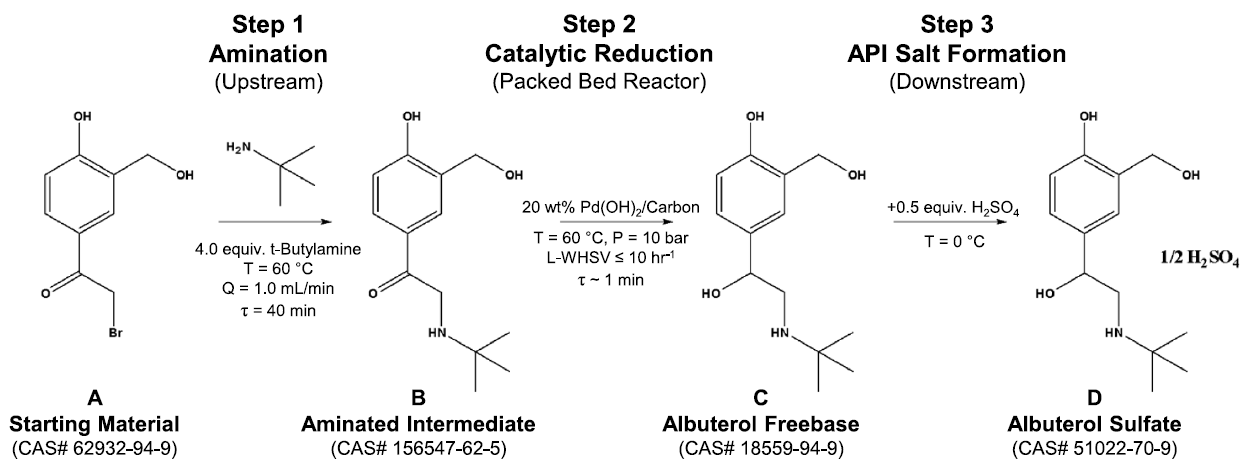
New synthetic chemistry route developed for continuous manufacturing of albuterol sulfate
Higher Catalyst Performance
The researchers evaluated two palladium catalysts: conventional 10 wt% Pd/C and 20 wt% Pd(OH)2/C, known as Pearlman’s catalyst. The latter performed significantly better, achieving approximately 99.5% conversion and 85% solution yield at a flow rate of 1.2 mL/min. The likely reason for the stronger performance is its improved activity to greater palladium dispersion, smaller active particle size, a higher concentration of accessible active sites, and the unique surface chemistry of Pearlman’s catalyst.
Identifying the Key Parameters
Continuous flow technology enabled the researchers to precisely measure reaction variables such as flow rate, temperature, hydrogen flow rate, and liquid throughput. The most important parameter turned out to be liquid weight hourly space velocity (L-WHSV), which describes the amount of reactant passing through the catalyst. When L-WHSV was no higher than 10 h-1, conversion and yield remained high. Above this threshold, both declined rapidly due to the reactant’s limited contact with the catalyst. Therefore, this variable should be considered an important parameter for future reaction scale-up.
Real-time Monitoring with NMR Spectroscopy
A major benefit of the continuous platform is its compatibility with process analytical technology (PAT). The research team connected an online 1H NMR instrument directly to the Phoenix™ Flow Reactor and monitored the albuterol product stream. After several hours of operation, they could detect gradual catalyst deactivation.
A Modular Platform for Scalable Pharmaceutical Manufacturing
By using the Phoenix™ Flow Reactor, the researchers highlighted several advantages:
- Reaction times reduced from hours to seconds
- High conversion and yield
- Precise control over reaction parameters such as pressure, temperature, and flow rates
- User-friendly catalyst handling
- High throughput in a compact reactor
- Compatibility with third-party analytical technologies
- A clear pathway toward scale-up
The work demonstrates how compact continuous-flow reactors such as the Phoenix™ can help transform pharmaceutical hydrogenation from a slow, equipment-intensive batch operation into a controllable, scalable, and potentially automated manufacturing process.