

As the end of 2025 is approaching, it is a valuable opportunity to reflect on the key developments. ThalesNano conducted valuable partnerships, visited many prestigious events, and had some truly competent people join the team.
We believe that we must give credit where credit is due, therefore, we are thankful to everyone who contributed to ThalesNano’s success this year. May you be blessed with good health, happiness, and a thriving career. Thank you for your continued trust in ThalesNano. Now, on to the upcoming events, fresh scientific materials, and product deals.

GeCatS Infoday
December 9, 2025
Frankfurt am Main, Germany
We were thrilled to be an exhibitor at GeCatS Infoday organized by DECHEMA this December. The conference was held on December 9, at the DECHEMA-Haus in Frankfurt, Germany. This one-day event’s aim was to bring together chemists from all around Europe, and foster discussions on greener technologies.
Our table highlighted our new H-Cube® Advance flow reactor and how it can become the core of larger, automated systems built for process development.
H-Cube® Advance distributor tour
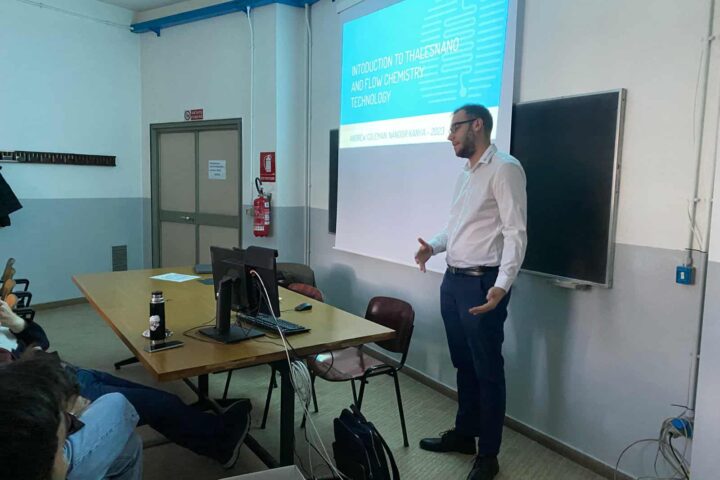
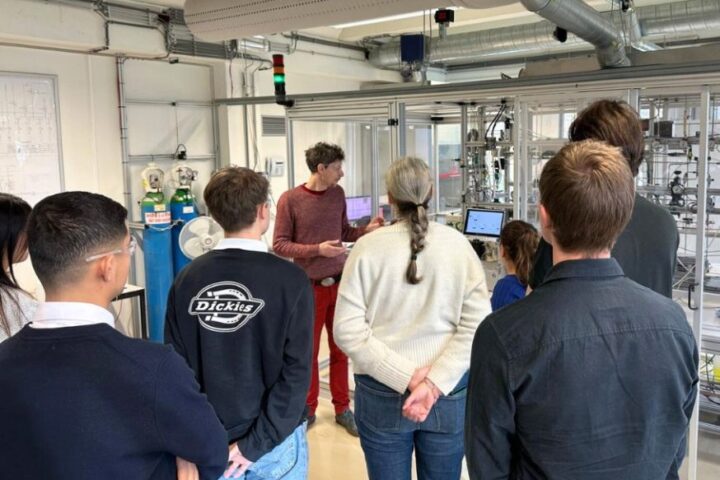
To familiarize several regions with our new H-Cube® Advance, we organized a tour in tandem with our distributors. In November, we have visited 3 Italian universities with Stepbio, and in December, the University of Ghent in Belgium with Beun-De Ronde. During the tour, our experts held a presentation, followed by a live demonstration of the H-Cube® Advance reactor at each location.
We were delighted to see that many chemists in the region were interested in the device, and we are thankful for all the assistance provided by our distributors to successfully conduct this tour. We hope our partnerships stay strong in the upcoming years as well.
2025 may be coming to a close, but the tour is not – keep an eye out for future updates on which regions we will visit in 2026.

Expedient Assembly of Multiantennary N‑Glycans from Common N‑Glycan Cores with Orthogonal Protection for the Profiling of Glycan-Binding Proteins (Wong et al., 2025)
Journal of American Chemical Society
This article highlights an efficient synthetic method to build structurally diverse, asymmetric, multi-antennary N-glycans. By employing a set of orthogonal protecting groups, they could elaborate each branch of the glycans. The modularity could be further enhanced by the synthesis of LacNAc units using Au(I)-promoted glycosylations and a programmable one-pot approach. The researchers conducted the final deprotection in continuous flow.
The researchers utilized the H-Cube® Mini for their deprotection process, which allowed them to synthesize 51 structurally defined N-glycans safely, quickly, and efficiently. Overall, the article provides needed insights to advance the fields of virology, immunology, and glycoscience.
Dynole-Based Dynamin Inhibitors as Novel Cytotoxic Agents (McCluskey et al., 2025)
ChemistrySelect
The paper reports the design, synthesis, and evaluation of a new series of dynole-based inhibitors targeting Dynamin, a key GTPase involved in membrane fission and endocytosis. By systematically modifying the dynole scaffold, they synthesized three libraries of dynole-based dynamin inhibitors to enhance their druglike properties while maintaining their cytotoxicity.
For the reduction process, they utilized the H-Cube® flow reactor with a 10% Pd/C catalyst. The reactor’s wide parameter space allowed for synthesis at high pressures and temperatures, which provided a safe and reproducible method for developing novel cytotoxic agents, potentially useful in cancer-related research.
Sugars in Antimicrobial Polymers – The Impact of Sugar-Lectin Binding in Membrane Interaction of Cationic Glycopolymers (Hartlieb et al., 2025)
Advanced Material Interfaces
This article investigates how the incorporation of sugar units into membrane-active antimicrobial polymers affects their overall antimicrobial activity. The group conducted photopolymerizations and used various analytical techniques to probe the interaction of polymers with bacteria, membrane models, and lectins.
The authors used ThalesNano’s PhotoCube for their photochemical syntheses, which allowed for excellent control over reaction temperature and light intensity. Ultimately, they found that the presence of sugar modulates both binding to membrane-associated lectins and the antimicrobial efficacy of polymers. This suggests that sugar-lectin interactions play an important role in how glycopolymers disrupt microbial membranes.
Additional Publications
If you would like to read more recent studies, visit ThalesNano’s publication database!

Last chance to get 10% off H-Cube® Advance Hastelloy
As a token of our gratitude towards our partners, we are offering the Hastelloy version of the H-Cube® Advance at a 10% discount until the end of 2025. This device provides additional features compared to its stainless steel counterpart; the whole liquid path is made from Hastelloy C, enabling the use of various corrosive agents like acids and oxidizers. Secure your discount as long as the supply lasts.
Contact us for the discount
Be among the first to receive updates from ThalesNano
Stay tuned for more scientific updates next month!
